Dear Bobath Therapist,
By completing the Basic Bobath Course in accordance with EBTA standards, you have made a strong start as a Bobath Therapist. You have learnt to conduct a holistic assessment of the child and family within the ICF framework, to examine the relationship between movement and function, and to provide clinical reasoning from a Bobath perspective.
But what about the first 12 months of life? Today, the risk of cerebral palsy (CP) can be identified in the first months of life, and current evidence clearly tells us: it is not a case of ‘wait and see’, but rather ‘detect early and act early’. This is because the 0–12-month period is not merely a time of rapid development; it is a unique window of opportunity in terms of brain plasticity, motor learning and experience-dependent development.
However, starting early is not enough on its own! The EBTA-certified, internationally recognised Advanced Bobath Infant Course is exclusively for Bobath therapists and builds upon the clinical reasoning skills you acquired in the Basic Bobath training, adapting them to the specific needs of infants at high risk of CP and those with neurodevelopmental issues identified at an early stage. What do I see in the Advanced Bobath Infant Course? Why do I see it? Why is this infant choosing this movement strategy? What experience supports their active movement and learning? And how do I translate this into the infant’s daily life? The course will enable you to address these questions using the Clinical Rationale Framework—developed exclusively within the Bobath concept—whilst aligning with the ICF.
Neuroplasticity—as highlighted by current early intervention science—along with active, baby-initiated movement, motor learning, task- and context-specificity, an enriched environment and family involvement, all align with the Bobath clinical rationale; during this period, no intervention takes place solely between the ‘baby and the therapist’. Listening to the family, strengthening parent-infant interaction—that is, strengthening the family—and transferring the opportunities we create in therapy into the infant’s real life form the foundation of early intervention.
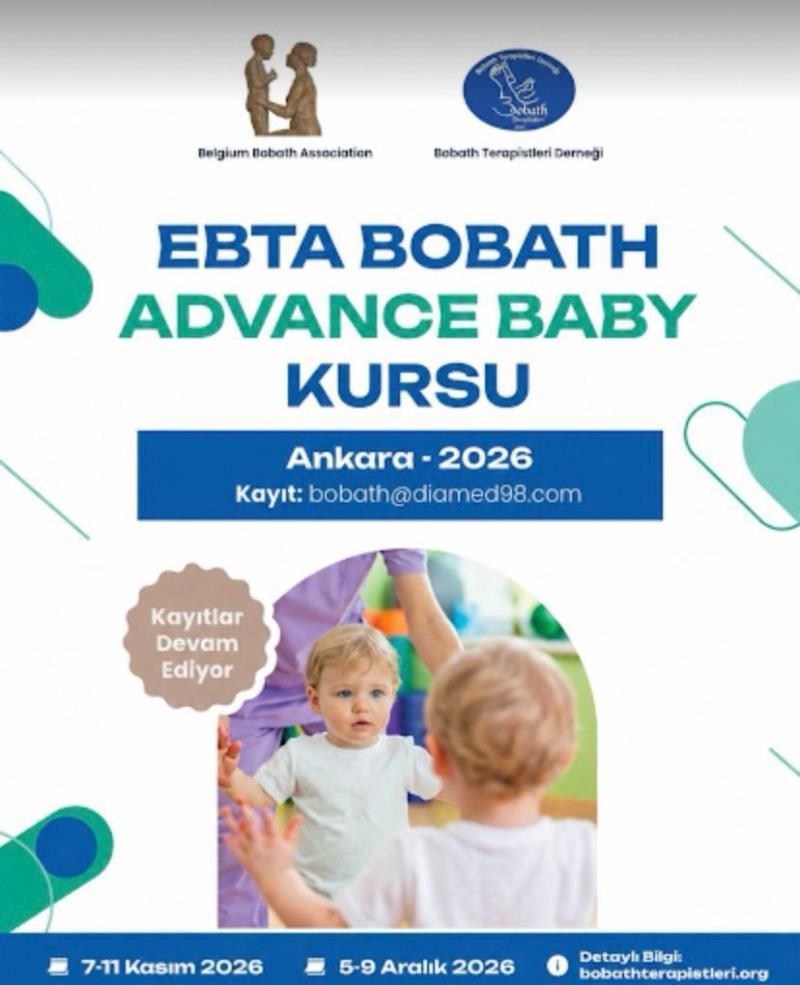
The Basic Bobath training has given you a strong start. Now is the time to bring this clinical perspective to the very earliest stages of life. Because early detection is important, and early intervention is important. But what we do, why we do it, when we do it and how we do it are far more important. As the Education Committee of the Turkish Bobath Therapists’ Association, we invite you to the EBTA Bobath Advanced Baby Course, featuring international Bobath trainers.
EBTA Bobath Advanced Baby Course in collaboration with the Turkish BTD and the Belgian BTD
Course Instructors:
Josse de Cat, Physiotherapist, Senior Bobath Instructor, BBTA, Belgium
He works at the University of Leuven, Belgium. He has served as the president of EBTA. For many years, she has been continuing her clinical and academic studies on Bobath applications in children with cerebral palsy as well as movement analysis, Botuluinum toxin applications, Selective dorsal rhizotomy, soft tissue and bone surgeries and Baclofen pump applications, pre and post physiotherapy programs and gait analysis.
Marleen D'hondt, Speech and Language Therapist, Senior Bobath Instructor, BBTA, Belgium
She is an associate professor at Gent University. She carries out her academic and clinical work in the department of speech and language therapy. She is interested in swallowing and eating problems in children with cerebral palsy. She is interested in oral motor problems in the neonatal period. She is also involved in Bobath courses as a speech and language therapist instructor.
Mintaze Kerem Günel, Physiotherapist, Senior Bobath Instructor, BTD, Turkey
She is a Professor at Hacettepe University Faculty of Physical Therapy and Rehabilitation. Her research interests include cerebral palsy high-risk infants, early childhood neurodevelopmental and especially children with motor function deficits, physiotherapy and rehabilitation applications in children with cerebral palsy and neuromotor childhood problems, ICF, postural control, motor learning. She continues her clinical practice and academic research on Bobath applications in cerebral palsy. She is EBTA second president, BTD board chair and EBTA Bobath senior instructor.
Feride Bilir, Physiotherapist, Senior Bobath Instructor, BTD, Turkey
She conducted clinical and academic studies in the field of risky babies, cerebral palsy and all developmental disorders in the Neonatal Intensive Care Unit and Pediatric Neurology Physiotherapy Units at Gazi University Faculty of Medicine, Department of PTR and Istanbul University, Istanbul Faculty of Medicine, Department of Pediatrics. After retiring from Istanbul University in 2012, she continues her practice and studies privately at the Early Intervention Center she founded in her own clinical center on Early Physiotherapy and Bobath applications in Risky Babies, Cerebral Palsy and developmental disorders seen in childhood. She is the vice president of BTD board of directors and EBTA Bobath senior instructor.
Course Dates: 7–11 November 2026 and 5–9 December 2026
Course Venue: Ankara,
Registration and contact: bobath@diamed98.com
Telephone: 05316284549
 Türkçe